Rural properties often come with big trees, long hedges and woodland edges, and with them a surprising amount of law. Felling the wrong tree, cutting a hedge at the wrong time or removing a hedgerow without notice can lead to fines, sometimes unlimited. This guide walks through the checks to make before any tree or hedge work, mainly for England, with notes on Scotland. It uses GOV.UK, Forestry Commission, Scottish Forestry and Natural England guidance and the legislation itself.
If you need a tree surgeon or hedge cutting, use the form on this page. We look for up to 3 local suppliers who cover your area. A good tree surgeon will check these permissions with you, but as the owner the responsibility is yours too.
Quick checklist before any tree work
- Is the tree protected by a Tree Preservation Order, or are you in a conservation area?
- Will the felling need a felling licence because of the volume of timber?
- Are birds nesting, or could bats be roosting?
- Is the hedge a protected countryside hedgerow?
- Does the tree overhang a neighbour, road or watercourse?
Tree Preservation Orders
This section follows the GOV.UK guidance for England. Scotland, Wales and Northern Ireland have their own tree protection systems, so check with your council there.
A Tree Preservation Order (TPO) is made by the local planning authority to protect trees in the interests of amenity. You usually need the authority's consent before cutting down, topping, lopping or otherwise working on a protected tree GOV.UK: TPO guidance. Ask your council whether a tree is protected before booking any work.
Exceptions
There are exceptions, including work on dead and dangerous trees, fruit trees, work to comply with an Act of Parliament and work needed to implement a planning permission GOV.UK. Even these come with conditions:
- Dead trees: unless the work is urgent because of an immediate risk of serious harm, you must give the authority 5 working days' written notice before cutting down or working on a dead tree. You can remove dead branches from a living tree without notice GOV.UK.
- Dangerous trees: if a tree presents an immediate risk of serious harm and urgent work is needed, you must give written notice to the authority as soon as practicable after the work becomes necessary GOV.UK.
Landowners must replace a protected tree removed in breach of an Order. The same duty applies if a tree outside woodland is removed because it's dead or presents an immediate risk of serious harm GOV.UK. Keep photos to show why the work was needed.
Applying for consent
You apply to the local planning authority, giving reasons for the proposed work GOV.UK. If the authority hasn't decided within 8 weeks, you can appeal for non-determination GOV.UK.
Penalties
In England and Wales, cutting down, uprooting or wilfully destroying a protected tree, or damaging, topping or lopping it in a way likely to destroy it, is an offence with an unlimited fine, whether the case is heard in the magistrates' court or the Crown Court. Other breaches of a TPO carry a fine of up to level 4 on the standard scale. The court must take into account any financial benefit from the offence Town and Country Planning Act 1990, s210.
Trees in conservation areas
Many villages and rural settlements are conservation areas. In England and Wales, trees there have protection even without a TPO Town and Country Planning Act 1990, s211. You must notify the local planning authority with a "section 211 notice" 6 weeks before carrying out certain work, unless an exception applies. The work can go ahead sooner if the authority consents GOV.UK.
During those 6 weeks the authority can make a TPO, tell you the work can go ahead, or let the notice period run out. After that you can do the work within 2 years GOV.UK. For a dead tree in a conservation area, 5 days' notice is needed unless there's an immediate risk of serious harm GOV.UK.
Felling licences
England
Larger felling jobs may need a licence from the Forestry Commission, even on private land with no TPO. You need a licence for trees with a diameter of 8 cm or more over bark, measured 1.3 m above the ground, if you'll fell more than 5 cubic metres in any calendar quarter. For coppice or underwood the threshold is 15 cm. You can sell up to 2 of those 5 cubic metres per quarter without a licence Forestry Commission.
There are exceptions, for example depending on where the trees are, preventing danger, and lopping and topping. If you rely on an exception, you must be able to prove it applies, so keep photos, maps and records Forestry Commission. Felling without a licence when one is needed is an offence, and everyone involved can be prosecuted, including landowners and contractors Forestry Commission.
Scotland
In Scotland, you must apply to Scottish Forestry for felling permission unless the work is exempt, and you mustn't start felling until written permission has been issued Scottish Forestry. Check the exemptions with Scottish Forestry before you start.
The GOV.UK guidance above is for England. Wales still uses its own tree preservation regulations, the Town and Country Planning (Trees) Regulations 1999, while England has had separate regulations since 2012 Welsh Government. Scotland and Northern Ireland have their own systems, so check with your council.
Nesting birds: the 1 March to 31 August season
In Great Britain, under the Wildlife and Countryside Act 1981, it's an offence to intentionally kill, injure or take any wild bird, or to take, damage or destroy the nest of any wild bird while it's in use or being built Wildlife and Countryside Act, s1. In Northern Ireland, wild birds and their nests are protected by the Wildlife (Northern Ireland) Order 1985 Wildlife (NI) Order 1985, art 4. GOV.UK says you must not do any work that might harm nesting birds or destroy their nests, and that the main nesting and breeding season runs from 1 March to 31 August GOV.UK.
Birds can nest outside those dates, so the law applies all year. For most rural properties, the practical answer is to schedule hedge cutting and major tree work for autumn and winter, and to check carefully for active nests before any work at other times.
Bats
In England, Natural England lists cutting down or removing branches from a mature tree among the activities that can harm bats, along with removing commuting habitats such as hedgerows. If you're found guilty of an offence, you could be sent to prison for up to 6 months, get an unlimited fine, or both Natural England. If a mature tree has cracks, holes or loose bark where bats might roost, get advice before the work.
Countryside hedgerows
In England, countryside hedgerows are protected under specific rules, and breaking them can mean an unlimited fine GOV.UK. A hedgerow is protected if it's more than 20 m long with gaps of 20 m or less, or less than 20 m long but meeting another hedge at each end. It must also be on or next to land such as agricultural or forestry land, land for keeping horses, ponies or donkeys, common land or a nature reserve GOV.UK. A hedge in, or marking the boundary of, a private garden isn't covered GOV.UK.
Discuss removing a hedgerow with the local planning authority first. Once it acknowledges your notice, it has 42 days to respond, either with a hedgerow retention notice or with written permission to remove the hedge as you proposed GOV.UK. You also need to check whether trees in the hedge need a felling licence or have a TPO GOV.UK.
Neighbours, roads and watercourses
Overhanging branches and high hedges
You can trim branches or roots that cross into your property from a neighbour's land or a public road, but only up to the boundary. If you go further, your neighbour could take you to court for damaging their property. In a conservation area, or if the trees are protected by a TPO, you may need the council's permission even for this GOV.UK.
If a neighbour's hedge is a problem, you must first try to settle it informally. If that fails, you can complain to the council about a hedge made up of 2 or more mostly evergreen or semi-evergreen trees or shrubs over 2 m tall that affects your enjoyment of your home or garden. The council may charge a fee GOV.UK. That GOV.UK process covers England and Wales. Scotland has the High Hedges (Scotland) Act 2013 High Hedges (Scotland) Act 2013, and Northern Ireland has the High Hedges Act (Northern Ireland) 2011, which also covers mainly evergreen or semi-evergreen hedges over 2 m High Hedges Act (NI) 2011, s2.
Roadside hedges and trees
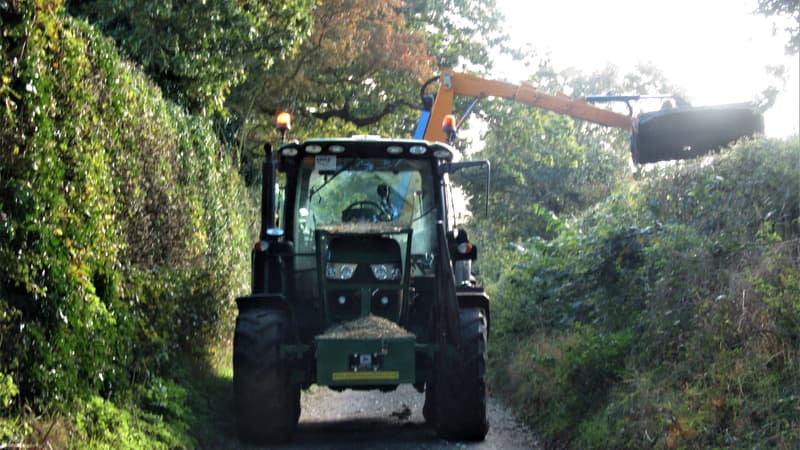
The highways authority can ask you to cut back hedges or trees on your property if they're obstructing the road. If you refuse, it can enter your property to do the work itself GOV.UK. Long roadside boundaries are a common rural job for tractor-mounted flails.
Ditches and streams
If you own land next to a watercourse, you may have to remove fallen trees or overhanging branches, or cut back trees and shrubs on the bank, if they reduce the flow or cause flooding to other landowners' property. You may have to pay damages if they do GOV.UK.
Power lines
Never cut trees near overhead power lines yourself, and don't ask an unqualified contractor to. Contact your electricity network operator first.
Choosing a tree surgeon
- Ask who will check for TPOs, conservation area status and felling licence needs, and who will submit any notices.
- Ask how they check for nesting birds and bats before starting.
- Check they have suitable insurance and get a written quote covering clearing away arisings, stump grinding and log splitting.
- For fencing after a hedge or tree removal, see our fencing and gates page.
Frequently asked questions
Can I cut down a tree in my own garden?
Often yes, but check first whether it has a TPO or is in a conservation area. In a conservation area in England and Wales you must give 6 weeks' notice TCPA 1990, s211. Large volumes of timber can also need a felling licence Forestry Commission.
What is the fine for cutting down a protected tree?
In England and Wales, cutting down or wilfully destroying a protected tree carries an unlimited fine in either the magistrates' court or the Crown Court TCPA 1990, s210.
When is it illegal to cut hedges?
It's an offence at any time to intentionally damage or destroy an active nest, under the Wildlife and Countryside Act 1981 in Great Britain WCA 1981 and the Wildlife (Northern Ireland) Order 1985 in NI Wildlife (NI) Order 1985. The main nesting season, when work is most likely to disturb birds, runs from 1 March to 31 August GOV.UK.
Do I need a felling licence for a few trees?
In England you can fell up to 5 cubic metres per calendar quarter without a licence, selling no more than 2 cubic metres, and other exceptions apply Forestry Commission. In Scotland, permission is needed unless an exemption applies Scottish Forestry.
Can the council make me cut my roadside hedge?
Yes. The highways authority can ask you to cut back hedges or trees obstructing the road, and can do the work itself if you refuse GOV.UK.