Slow or unreliable broadband is one of the most common frustrations of rural life, and it matters more than ever when you work from home, run a farm business or rely on online services. The good news is that there are now more ways to get connected than ever. This guide explains each option, your legal right to a decent connection, what the government's Project Gigabit means for you, and the questions to ask before you sign up.
If you need a signal survey, an external antenna, a satellite dish fitted or Wi-Fi run to an outbuilding, use the form on this page. We look for up to 3 local suppliers who cover your area.
Understanding broadband speeds
Providers use different terms, so it helps to know the official definitions. GOV.UK says:
- Superfast broadband offers download speeds of over 30 Mbps
- Ultrafast broadband offers download speeds of over 100 Mbps
- a gigabit-capable connection is a wired connection capable of at least 1 Gbps (1,000 Mbps)
Source: GOV.UK: Project Gigabit. To put that in context, GOV.UK estimates a 4 GB high-definition film would take about 30 seconds to download on a 1 Gbps full fibre connection, around 5 minutes at 100 Mbps and around 18 minutes at 30 Mbps GOV.UK. GOV.UK also points to Ofcom's website to check what speeds are available at your address GOV.UK.
Your options in a rural home
Full fibre (FTTP)
With full fibre, fibre-optic cables run all the way to your home instead of copper, giving higher speeds and a more reliable service, and an engineer needs to install the connection GOV.UK. GOV.UK says fibre-optic networks have fewer faults than copper-based networks and are faster to repair on average GOV.UK. In rural areas, full fibre may come from Openreach, an alternative network ("altnet"), or a community project. You don't have to buy a gigabit package: you can choose a lower speed on a full fibre line.
Part fibre (FTTC) and ADSL
With part fibre, fibre runs to a street cabinet and copper completes the connection. GOV.UK says FTTC is faster than ADSL but slower than full fibre, and your speed may depend on how far the cabinet is from your home GOV.UK. That's why many rural homes a long way from the cabinet get poor speeds. ADSL broadband over BT copper phone lines is being phased out by 31 January 2027, as part of the retirement of the copper telephone network GOV.UK.
Fixed wireless access
Fixed wireless connects your home using radio signals, including 4G or 5G, instead of cables. GOV.UK says it typically provides superfast or ultrafast speeds and sometimes gigabit speeds GOV.UK. Some local providers run their own masts and point a small antenna on your house at them. Others use the mobile networks.
4G and 5G home broadband
A 4G or 5G router can work well where there's a reasonable mobile signal. In a stone farmhouse or a valley, an external antenna on the roof or a pole often makes a big difference. A local installer can survey which masts you can reach and which network is strongest before you commit to a contract.
Satellite
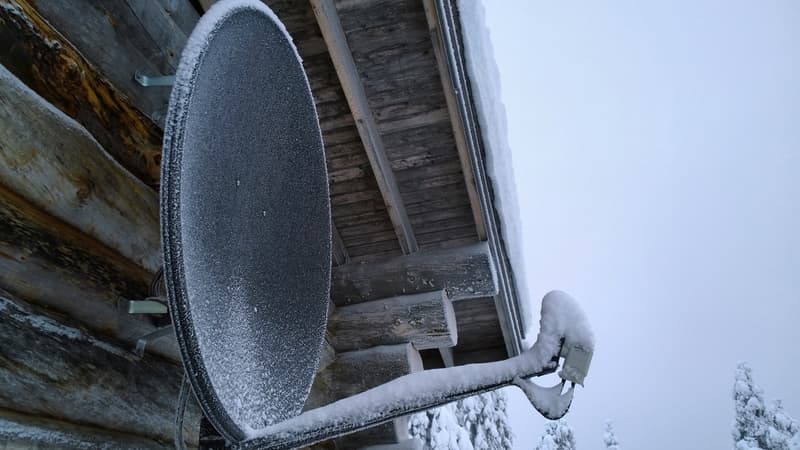
Satellite broadband transmits signals to equipment installed at your property. GOV.UK says it can connect remote or very hard to reach areas where other options are limited, can serve as a backup connection, and that advances in satellite technology mean some services now offer ultrafast speeds GOV.UK. You'll need a clear view of the sky, and the dish placement matters.
Your legal right to a decent connection: the USO
The Broadband Universal Service Obligation (USO) gives you the right to request a decent, affordable connection. Under the Order, the connection must have:
- a download sync speed of at least 10 Mbit/s
- an upload sync speed of at least 1 Mbit/s
- a contention ratio of no more than 50:1
- latency that lets you make and receive voice calls effectively
- the ability to use at least 100 GB of data a month
Source: USO Order 2018.
The £3,400 threshold
The Order's eligibility conditions include that a connection with those characteristics isn't already available, won't be provided through a publicly funded scheme within one year of your request, and will cost no more than £3,400 to provide. If it will cost more than £3,400, you can still have it if you pay the amount above £3,400 USO Order 2018. For many remote homes, this is the cheapest route to a fixed line. See our rural broadband costs page.
Project Gigabit and vouchers
Project Gigabit is the government's programme to bring gigabit-capable broadband to homes and businesses not in suppliers' commercial plans. The government expects 99% of premises to have access to a gigabit-capable connection by 2032, and has signed over 30 Project Gigabit contracts GOV.UK.
Its Gigabit Broadband Voucher Scheme offered vouchers worth up to £4,500 each, which suppliers could pool towards the cost of installing gigabit-capable broadband in an area. GOV.UK says the scheme closed to new voucher project submissions on 31 August 2026. Delivery of existing voucher projects continues until the scheme's planned closure on 31 March 2028, or each project's agreed end date if earlier GOV.UK. If a voucher project or Project Gigabit contract already covers your area, ask the supplier for its timetable.
The copper switch-off and your landline
The old copper telephone network (PSTN) is being retired, and ADSL services will be phased out by 31 January 2027 GOV.UK. Home phones are moving to calls over broadband. In a rural home, that raises practical questions:
- Will your phone work in a power cut? A digital line needs powered equipment, so ask your provider about battery backup, especially if anyone relies on a telecare alarm.
- Do you have mobile signal at home as a fallback?
- Are alarms, lift lines or farm equipment connected to the phone line?
Our winter preparedness guide covers planning for power cuts.
Getting the best from your connection
Thick stone walls and spread-out farm buildings can stop Wi-Fi reaching where you need it, even with a fast line. Common fixes include:
- moving the router to a central, high position
- a mesh Wi-Fi system with units in each part of the house
- running a network cable, or a point-to-point wireless link, to an office, barn or holiday let
- an external antenna for 4G or 5G routers
A local installer can survey your property and recommend the right mix.
Which option suits your home?
There's no single best answer for every rural property. A simple way to decide:
- Check what's available at your address. Start with the speed checker on Ofcom's website, which GOV.UK recommends GOV.UK, then ask local providers directly, as small wireless and fibre networks don't always show up in national checkers.
- If full fibre is available or planned soon, it's usually the most future-proof choice. Ask whether there's an installation charge for a long driveway or track.
- If not, test the mobile signal. A good 4G or 5G signal, perhaps with an external antenna, can give a big improvement quickly and without digging.
- Look for a local fixed wireless provider. They may be able to reach you from a nearby mast.
- Consider satellite where nothing else works, or as a backup for a home business.
- If your connection is below the USO standard, consider making a USO request alongside any interim fix.
Whichever route you choose, think about upload speed, reliability in bad weather and what happens in a power cut, not just the download headline.
Questions to ask before you sign up
- What speed is realistic at my address, not just the headline speed?
- What's the upload speed? It matters for video calls and backups.
- How long is the contract, and what does installation cost?
- What equipment is included, and who owns it?
- Is there a data cap?
- What happens to my landline and phone number?
- How are faults reported and how quickly are they fixed?
Get the answers in writing, and compare at least two or three options. Use the form on this page, or read more on our rural broadband page.
Frequently asked questions
What is the minimum broadband speed I'm entitled to?
Under the Broadband USO, you can request a connection with at least 10 Mbit/s download and 1 Mbit/s upload, subject to the Order's conditions USO Order 2018.
Will I have to pay for a USO connection?
If the connection costs more than £3,400 to provide, you'd need to pay the amount above £3,400 USO Order 2018.
Can I still get a gigabit broadband voucher?
The Gigabit Broadband Voucher Scheme closed to new voucher project submissions on 31 August 2026, though existing projects continue GOV.UK.
Is satellite broadband any good now?
GOV.UK says advances in satellite technology have improved performance, with some services now offering ultrafast broadband, and that it suits remote areas where other options are limited GOV.UK.
When is ADSL being switched off?
GOV.UK says ADSL services will be phased out by 31 January 2027 as part of the retirement of the copper telephone network GOV.UK.