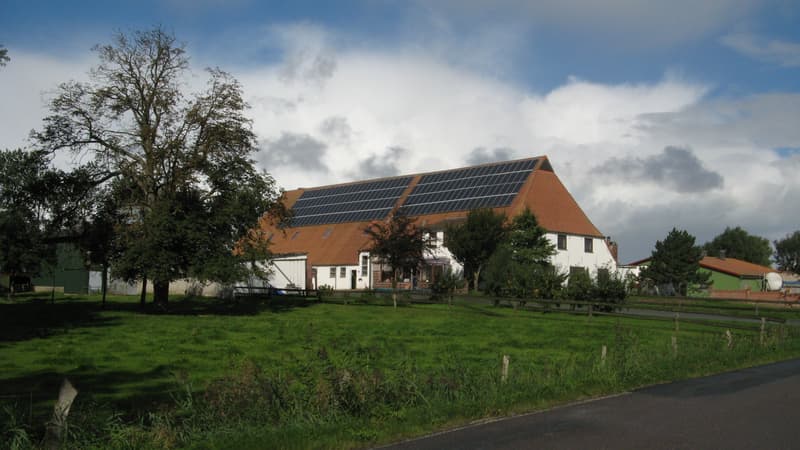
Rural homes are often well placed for solar. Many have large, unshaded roofs, outbuildings or a paddock with room for a ground-mounted array. They also tend to have higher energy costs, because they're off the gas grid or heated electrically or with a heat pump. This guide covers what solar panels and batteries cost, how export payments work, when you need planning permission and what upkeep to expect, using figures from the Energy Saving Trust, Ofgem, HMRC and planning law.
If you'd like quotes, use the form on this page. We look for up to 3 local suppliers who cover your area.
How solar panels work
Solar photovoltaic (PV) panels turn sunlight into direct current electricity. They work even on cloudy days, though stronger sunshine generates more Energy Saving Trust. An inverter turns that into the alternating current (AC) electricity that household appliances use EST.
The Energy Saving Trust says the average home system is around 4.5 kilowatt peak (kWp), which is the most power the system can generate in ideal conditions. A system that size typically covers 20 to 30 m² of roof EST.
Is your property suitable?
- Orientation. An unshaded, south-facing roof is ideal. East- or west-facing roofs still work but tend to get around 15 to 20% less energy than one facing directly south. The Energy Saving Trust doesn't recommend north-facing roofs EST.
- Shade. Nearby buildings, trees or chimneys can reduce output. Optimisers can limit the impact of shading so that one shaded panel doesn't affect the rest EST.
- Roof condition. Sometimes it's worth renewing the roof covering before panels go on. That adds to the cost but can be cheaper in the long run EST. Older rural roofs are worth checking first, and our roofing page covers repairs.
- Where you live. Areas further south get more direct sunlight, which affects savings EST.
Ground-mounted panels
Panels can also go in the garden on a suitable frame. They should be as south-facing as possible and away from shade from trees and buildings EST. Ground-mounted panels are easier to keep clean, but you need to be more careful about rodents and physical damage EST. Their cost is harder to predict because it depends on the type of mounting frame and how far the array is from the house EST. That distance matters on rural plots where the best spot may be a field away.
What solar panels cost
The Energy Saving Trust puts a typical 4.5 kWp home system at around £7,600 to install EST. The cost depends on EST:
- the size of the system
- how hard it is to access your roof
- whether you choose panels or solar tiles, and whether they're integrated into the roof
- whether the roof covering needs renewing
You can lower the installation cost if scaffolding is already up for roof repairs EST.
Battery storage
A battery stores surplus solar electricity so you can use it when your panels aren't generating, which means buying less from the grid at peak times. The Energy Saving Trust says battery storage tends to cost around £5,000 to £8,000 EST. Combined with a time of use tariff, a battery lets you store daytime solar and avoid expensive periods. On some tariffs you can also sell stored electricity at peak times EST.
A battery isn't the same as backup power. Whether a solar and battery system keeps running during a power cut depends on how it's designed and installed. If you want backup during outages, ask installers about that specifically. Our off-grid power page covers generators and safe changeover.
VAT relief
HMRC applies a zero rate of VAT to installing energy-saving materials, including solar panels, in homes from 1 May 2023 to 31 March 2027 HMRC VAT Notice 708/6. From 1 February 2024, electrical storage batteries installed in homes also qualify. That includes retrofitting a battery to existing solar panels and installing a standalone battery that stores grid electricity HMRC. The relief applies when an installer supplies and fits the equipment, not when you buy materials from a retailer HMRC.
Grants and funding
The Energy Saving Trust says there aren't any dedicated solar panel grants from the UK Government, although you may get funding through other government schemes. It suggests asking your energy supplier whether it offers any support EST. It also notes that, under the Warm Homes Plan, people on low incomes are due to get fully funded support for solar panels, alongside low and zero-interest loans for homeowners EST.
In Scotland, Home Energy Scotland's grant and loan table includes hybrid solar PV/water heating (PV-T) systems, but standard solar PV isn't listed Home Energy Scotland.
Getting paid for exports: the Smart Export Guarantee
The Smart Export Guarantee (SEG) requires some electricity suppliers, known as SEG licensees, to pay small-scale generators for electricity they export to the grid Ofgem. Eligible technologies include solar PV, wind and hydro. Installations must be in Great Britain and have a capacity of no more than 5 MW Ofgem: SEG generators.
- Each licensee sets its own rate and contract length, but the tariff must always be above zero Ofgem.
- Payments are based on export meter readings Ofgem.
- Your SEG licensee doesn't have to be your electricity supplier, so shop around Ofgem.
The Energy Saving Trust says you typically get around 12p for each unit you export, but you'd normally pay more than twice that to buy a unit, so it often makes more sense to use the electricity yourself EST. In Northern Ireland, the SEG doesn't apply. The Energy Saving Trust suggests asking your energy supplier whether it offers an export tariff EST.
Payback
The Energy Saving Trust's payback estimates, including export payments and based on July 2026 fuel prices, are about 9 years in London (whether you're home all day or out all day), 9 years in Aberystwyth (10 years if you're out all day), 10 to 11 years in Manchester and 11 to 12 years in Stirling EST. How much you save depends on how much solar electricity you use yourself, whether you get export payments and where you live EST.
Planning permission
Solar panels on houses are usually permitted development and don't usually need planning permission. There may be extra restrictions for listed buildings, conservation areas and national parks, so check with your local planning office EST.
In England, the General Permitted Development Order sets out the conditions. The rules for houses were updated by SI 2026/896 from 27 August 2026 GPDO Schedule 2 Part 14:
- Roof panels on a pitched roof mustn't protrude more than 0.2 m beyond the roof slope or rise above the highest part of the roof, not counting chimneys. On a flat roof, the highest part mustn't be more than 0.6 m above the highest part of the roof.
- Wall-mounted panels mustn't protrude more than 0.2 m beyond the wall where the wall abuts a highway, or more than 0.4 m in any other case. The same 0.2 m and 0.4 m limits apply to panels on a balcony or roof enclosure.
- Equipment isn't permitted development on a listed building or on a scheduled monument site.
- In a conservation area or World Heritage Site, it can't go on a wall, balcony or roof enclosure that fronts a highway.
- Plug-in solar isn't permitted development on a wooden wall, balcony or enclosure, or on any part of the house that's clad in timber. Stand-alone plug-in solar can't be fixed to a wooden fence, gate, wall or other means of enclosure.
Ground-mounted (stand-alone) solar at a house
For stand-alone solar in the garden of a house, the height limit is the lowest that applies GPDO Part 14, Class B:
- 1 m if any part is within 5 m of the boundary and on land in front of a wall forming part of the house's principal elevation
- 2 m if any part is within 5 m of the boundary
- 2 m in a conservation area, if it's nearer to a highway bounding the garden than the nearest part of the house
- 4 m in any other case
The total surface area of the panels must not exceed 9 m². It isn't permitted within the curtilage of a listed building or on a scheduled monument. On a World Heritage Site, it also can't go nearer the highway than the house or within 5 m of the boundary GPDO Part 14. The old blanket ban on ground-mounted solar within 5 m of the boundary now applies only on World Heritage Sites and to blocks of flats, and the 3 m maximum dimension for an array no longer applies to houses (it still applies to flats) GPDO Part 14. Arrays bigger than this, or on land outside your garden, such as a field, need planning permission.
Wales, Scotland and Northern Ireland have their own rules, so check with your council before you commit.
Telling the network operator
You must register a solar system with your Distribution Network Operator (DNO), the company that brings electricity to your home. Your installer will usually do this for you. In Northern Ireland, the installer registers the system with NIE Networks EST.
Choosing an installer
MCS certifies installers and products for small-scale renewables, including solar panels and battery storage MCS. Home Energy Scotland requires an MCS installer and an MCS or Solar Keymark certified product for renewables it funds Home Energy Scotland. When comparing quotes, ask for:
- the system size in kWp and an estimate of annual generation for your roof or site
- panel, inverter and battery make and model, with warranty terms
- who will register the system with the DNO
- scaffolding, any roof repairs, and cable runs for ground-mounted arrays
Lifespan and maintenance
Solar panels should last 25 years or more, but you'll probably need to replace the inverter after around 12 years EST. Most inverters have at least a five-year warranty, which can often be extended up to 15 years, though a long warranty can cost almost as much as a new inverter EST.
In the UK, rain usually cleans panels tilted at 15 degrees or more. Ground-mounted panels and dusty areas may need occasional cleaning EST. That may apply near farmyards or tracks. Your installer should leave written details of the maintenance checks to make and the main inverter fault signals EST.
Frequently asked questions
How much do solar panels cost for a rural house?
The Energy Saving Trust puts a typical 4.5 kWp home system at around £7,600. Roof access, roof repairs and ground mounting all affect the price EST.
Do I need planning permission for solar panels in a field next to my house?
In England, stand-alone solar within the garden of a house is permitted development if the panels total no more than 9 m² and it stays within the height limits: 4 m generally, 2 m within 5 m of the boundary or nearer a highway in a conservation area, and 1 m within 5 m of the boundary in front of the house's principal elevation GPDO Part 14. A field outside your garden, a listed building or a larger array needs planning permission or advice.
How much will I get paid for exported electricity?
Under the Smart Export Guarantee, each supplier sets its own rate, which must be above zero Ofgem. The Energy Saving Trust says around 12p a unit is typical EST.
Is there VAT on solar panels and batteries?
No, when they're installed in a home. Installation is zero-rated until 31 March 2027, and batteries have qualified since 1 February 2024 HMRC.
How long do solar panels last?
The Energy Saving Trust says 25 years or more, but you'll probably need to replace the inverter after about 12 years EST.