For homes off the gas grid, the oil tank in the garden is the heart of the heating system, and one of the easiest parts to forget about. Tanks age, bases subside, and a leak can pollute a well or stream and cost far more to clean up than a new tank. Thieves target rural tanks too, especially when prices are high. This guide sets out the official rules on where a domestic oil tank can go, when it needs a bund, how to spot a tank that needs replacing, what to do about a spill and how to deter theft.
If you need a new tank, a tank inspection or a boiler service, see our heating oil, boilers and tanks page or use the form on this page. We look for up to 3 local suppliers who cover your area.
Which rules apply to a home oil tank?
In England, a new or replacement oil storage container at your home, for example one fuelling your central heating or cooker, must meet building regulations. Wales, Scotland and Northern Ireland have their own building regulations. If your container can hold 3,501 litres or more, the rules for businesses apply instead GOV.UK.
In Scotland, SEPA's general binding rule covers oil stored at a private dwelling in a container of 2,500 litres or less that is used only to serve a fixed heating or cooking appliance. If you follow the rules you don't need to apply to SEPA. The main requirements are that the container is strong enough not to burst or leak in ordinary use, and that any container installed or altered complies with Scottish building regulations SEPA.
Use a registered installer
In England, installing a new or replacement oil tank is notifiable building work, unless your installer is registered with a Competent Person Scheme. Schemes covering oil-fired boilers and storage tanks include OFTEC and several others GOV.UK. GOV.UK advises choosing someone registered with a competent person scheme, because they can self-certify that the work complies. If you don't, you'll need a Building Control Notice from your council, and you'll have to arrange and pay for an inspection yourself. Without approval you won't have the compliance certificates you may need when you sell GOV.UK.
OFTEC says its registered technicians can self-certify new installations in England and Wales, a similar optional scheme exists in Scotland, and in Scotland you may need to apply for a building warrant if you don't use a registered installer OFTEC. GOV.UK also warns that you're responsible for making sure the installer's work meets the regulations, and that the local authority could make you pay to fix faulty work GOV.UK.
When does a tank need a bund?
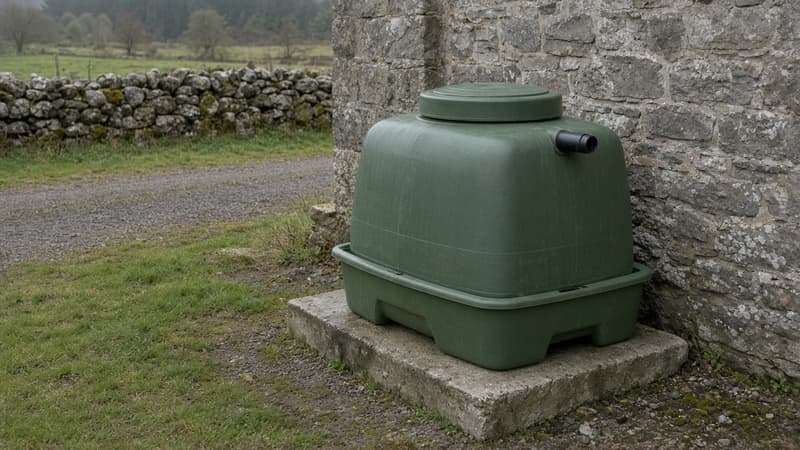
A bund (secondary containment) is a second skin or wall around the tank that catches oil if the tank leaks. In England, the installer carries out a risk assessment and tells you if one is needed. A bund must hold 110% of the tank's capacity and be impermeable to oil and water GOV.UK. You'll need one if the tank:
- is where spilled oil could run into an open drain or a loose manhole cover
- has vent pipes that can't be seen while it's being filled, for example because the tanker parks too far away
- is within 10 metres of coastal waters or inland fresh waters such as lakes or streams
- is within 50 metres of a drinking water source such as a well, borehole or spring
- is where spilled oil could run over hard ground and reach coastal waters, inland fresh waters or a drinking water source
- is in the inner zone of groundwater source protection zone 1
- holds more than 2,500 litres
Source: GOV.UK.
Scotland's domestic building standards take a very similar approach. External above-ground tanks of up to 2,500 litres should have a catchpit or be integrally bunded if, for example, they're within 10 m of a river, loch or coastal water, within 50 m of a borehole or spring, where a spill could reach an open drain or run off into a watercourse, or where the vent pipe outlet can't be seen from the fill point Scottish Government. Rural homes on a private water supply often meet at least one of these conditions, so in practice many need a bunded tank.
Every new tank in England must also carry a sticker in a prominent position explaining how to look after your oil and what to do in a spill. The installer fits it GOV.UK.
Where a tank can go: fire separation distances
OFTEC's home guide gives the following distances to protect stored fuel from fire. Tanks should be sited OFTEC:
| Distance from | Minimum |
|---|---|
| Non-fire-rated eaves of a building | 1.8 m |
| A non-fire-rated building or structure, such as a garden shed | 1.8 m |
| Doors or windows in a fire-rated building, such as a brick house or garage | 1.8 m |
| Oil appliance flue terminals | 1.8 m |
| A non-fire-rated boundary, such as a wooden fence | 760 mm |
| Screening that isn't part of the boundary, such as trellis or plants | 600 mm |
If those distances can't be met, OFTEC says a fire protection barrier with at least a 30-minute fire rating should be provided, normally at least 300 mm from the tank. A tank can go inside a garage or outbuilding, but only within a self-contained chamber with a 60-minute fire rating OFTEC. These rules also matter if you later build a shed, put up a fence or extend the house near an existing tank.
The tank base
OFTEC says the base must give continuous support as ground conditions change through the seasons. It should be strong enough for the tank and its contents (1,000 litres of fuel weighs just under a tonne), non-combustible, imperforate and level, built of concrete, paving stones or stonework, and extend 300 mm beyond every side of the tank OFTEC.
How long does a tank last, and when should it be replaced?
OFTEC says fuel tanks have an expected working life of around 20 years, and the risk of a costly failure increases with age. Your tank should be inspected every year at your heating system service, and your technician will tell you when it should be replaced OFTEC. Check it yourself between services too, especially after extreme weather. OFTEC's warning signs are OFTEC:
- rust
- splits or cracks
- bulging
- gauges falling over or not working
- subsidence of the base
- a sudden increase in fuel use
- a tank overgrown with plants
- a strong smell of fuel
Your oil delivery driver may also flag problems. OFTEC notes that suppliers commonly put a warning notice on a defective tank and, in extreme cases, could refuse to deliver OFTEC. That's worth remembering before winter, when running out of oil is far more than an inconvenience. Our winter preparedness guide covers ordering fuel early.
OFTEC recommends that new tanks are made to its standards: OFS T100 for plastic and OFS T200 for steel OFTEC.
Leaks and spills: what to do
OFTEC reminds owners that maintaining the tank is their responsibility, and that spills and leaks can be extremely costly to clean up. They can contaminate groundwater and even building foundations. Check whether your home insurance covers fuel spills or leaks, and whether it has any conditions OFTEC.
If oil does leak, GOV.UK says to stop it spreading if you can and follow the advice on your tank sticker and the Oil Care website. Don't try to clean up the spill yourself. Get help from your insurer, the Environment Agency (in England) and your oil supplier. You may face legal action if a spill pollutes a watercourse GOV.UK. In Scotland, Wales and Northern Ireland, contact SEPA, Natural Resources Wales or the Northern Ireland Environment Agency respectively. If you have a private water supply, tell whoever tests it, as oil can taint wells and boreholes.
Protecting your oil from theft
Police Scotland says thieves usually decant, siphon or pump oil from a tank into other containers. Its advice Police Scotland:
- lock your tank if possible
- install suitable lighting or CCTV
- if you can, site the tank where it can be seen from a lived-in building
- consider a fuel tank alarm or monitoring system, which can sound if the level drops suddenly or falls below a set point
Other practical steps include checking your oil level regularly, so you notice losses quickly, and keeping gates to the yard or drive closed. Any lock, cage or screen must still respect the fire separation distances above and leave room for the delivery driver and servicing. Ask your installer before you enclose a tank. Report suspicious activity to the police on 101, or 999 if a crime is in progress.
Help with oil costs in Northern Ireland
Many homes in Northern Ireland heat with oil. For winter 2026–27, the Department for Communities runs a Home Heating Oil Support Scheme. Eligible households can apply for a £100 voucher to use with any NI oil supplier, and applications are open from 9 September 2026 to 31 March 2027. It's open to NI residents who use oil as their main heating and who, in April or November 2026, were on a qualifying benefit or had an annual income under £30,000 (net of allowable deductions) Department for Communities.
Thinking about moving off oil?
If your tank is near the end of its life, it's a natural moment to compare options. In England and Wales, the Boiler Upgrade Scheme currently offers an extra £1,500 towards an air or ground source heat pump, until March 2027, if your property is heated by oil or LPG and has no mains gas connection GOV.UK. See our heat pump grants guide and our off-grid heating comparison.
Frequently asked questions
Do I need a bunded oil tank?
In England, you need one if the tank holds more than 2,500 litres or meets any of the risk conditions, such as being within 10 m of a stream or 50 m of a well, borehole or spring. A bund must hold 110% of the tank's capacity GOV.UK. Scotland has similar conditions Scottish Government.
How long does a heating oil tank last?
OFTEC gives an expected working life of around 20 years, with the risk of failure rising with age. Have it inspected at every annual service OFTEC.
Can I replace my own oil tank?
In England, replacing an oil tank is notifiable work. Unless you use a Competent Person Scheme installer, such as an OFTEC-registered technician, you'll need a Building Control Notice and an inspection GOV.UK GOV.UK.
How close can an oil tank be to my house?
OFTEC advises 1.8 m from non-fire-rated eaves and from doors and windows, and 760 mm from a non-fire-rated boundary such as a wooden fence. If that isn't possible, a fire barrier is needed OFTEC.
Who do I call if my tank leaks?
Your insurer, your oil supplier and the environment regulator. In England that's the Environment Agency. Don't try to clean up the spill yourself GOV.UK.