Old rural houses often have roofs that have been patched for generations: natural slate, stone slate, clay pantiles or thatch, over timbers that may never have been designed for modern loads or insulation. Exposed sites mean wind and driving rain test every weak point. When a roof needs more than a few slipped slates fixing, it's worth knowing which permissions apply before work starts. This guide covers building regulations, planning, listed building consent, bats and safe working, using Planning Portal, legislation, Natural England and HSE sources.
The detailed rules below are mainly for England. Scotland, Wales and Northern Ireland have their own building standards and planning systems, so check with your council. If you need a roofer, see our roofing page or use the form on this page. We look for up to 3 local suppliers who cover your area.
Repair or replacement? Why it matters for building regulations
The Planning Portal says repairing or re-covering an existing pitched or flat roof doesn't normally need a building control application if less than 25% of the total building envelope and less than 50% of the roof is affected Planning Portal. You will need approval if Planning Portal:
- you exceed those limits, in which case you may also need to make sure the thermal insulation is sufficient
- you make structural alterations
- the new covering performs significantly differently from the old one in a fire
- the new covering increases the weight of the roof covering by 15% or more
That last point matters on old houses. Swapping a light covering for heavy stone slates or concrete tiles can overload old timbers. The Planning Portal warns that removing or altering roof elements can cause movement, cracking in walls and possibly eventual collapse Planning Portal.
GOV.UK lists a replacement roof as an example of notifiable building work. If your roofer isn't registered with a Competent Person Scheme, you'll need to apply to a Building Control Body. If you don't comply, the work won't be legal and you could face unlimited fines. When you sell, you may be asked for compliance certificates GOV.UK. If a scheme-registered installer does the work, you should receive a certificate within 30 days of completion GOV.UK.
Do you need planning permission?
In England, re-roofing that doesn't materially affect the external appearance of a house usually doesn't need planning permission Planning Portal. Changing the look of the roof, for example swapping natural slate for a different material, can be a different matter. Permitted development rights for other roof alterations such as rooflights come with limits. Rooflights must not project more than 150 mm from the roof slope or exceed the height of the existing roof, and the rights don't apply to flats Planning Portal. If permitted development rights have been removed in your area, you'll need to apply Planning Portal. Many rural villages are conservation areas, so ask the council before changing materials.
Listed buildings: get consent first
Many old farmhouses, cottages and barns are listed. In England and Wales, carrying out works to alter a listed building in a way that affects its character without listed building consent is a criminal offence. So is failing to comply with conditions attached to a consent Listed Buildings Act, s9. The maximum penalty on indictment is two years' imprisonment or a fine, or both Listed Buildings Act, s9.
There is a defence for genuinely urgent works, but only if the works were urgently necessary for safety, health or the preservation of the building, temporary support or shelter wasn't practicable, the work was limited to the minimum immediately necessary, and you gave the council written notice justifying it in detail as soon as reasonably practicable Listed Buildings Act, s9. In practice, if a storm damages a listed roof, make it weathertight with temporary measures, take photographs and speak to the council's conservation officer before permanent repairs.
Like-for-like repairs using matching materials and methods are less likely to affect character than changes of material. But whether consent is needed is a question for the council, not your roofer.
Bats in the roof
Old roofs and lofts are classic bat roosts. In England, all bat species, their breeding sites and resting places are fully protected by law Natural England. Natural England's guidance for England lists repairing or replacing a roof and insulating or converting a loft among the activities that can harm bats. Offences can lead to up to 6 months in prison, an unlimited fine, or both Natural England.
If you think there's a roost, the guidance says you can contact the National Bat Helpline, run by the Bat Conservation Trust, for free advice on small-scale works Natural England. Larger jobs may need a bat survey by an ecologist and, if disturbance can't be avoided, a licence from Natural England Natural England. Separate guidance applies in Scotland, Wales and Northern Ireland. Bat checks can affect when work can happen, so raise them early.
Safety: roof work is high risk
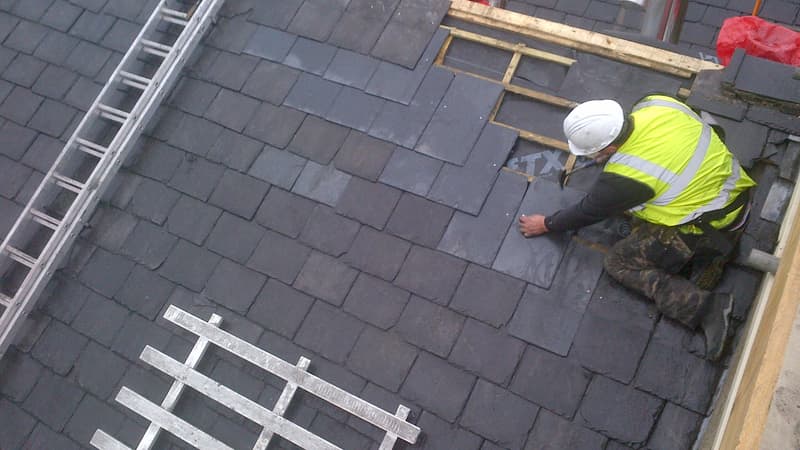
HSE says almost one in five deaths in construction work involve roof work. The main causes are falls from edges or openings and through fragile roofs and rooflights HSE. Sloping roofs require scaffolding to stop people or materials falling from the edge, with edge protection at the eaves. Secured ladders and roof ladders are only for short tasks measured in minutes HSE.
Old farm buildings often have fragile roof sheets and rooflights, so don't walk on them. Ask any roofer how they will provide safe access, and expect scaffold costs to be part of the quote.
Materials on old rural roofs
Natural slate and stone slate
Many traditional rural roofs use regional slate or stone. Where a roof is being repaired, reusing sound slates and sourcing matching ones keeps the character and avoids questions about changing materials. Check that a replacement covering won't raise the roof's weight by 15% or more without building control approval Planning Portal.
Thatch
Thatched roofs need specialist thatchers. Many thatched homes are listed, so consent rules apply to changes in thatch type or style. We couldn't verify official figures on thatch lifespans or costs, so we haven't quoted any. Ask your conservation officer and thatcher about your roof.
Chimneys, flashings and valleys
Most leaks on old roofs start at chimney flashings, valleys and verges rather than the main slope. If you burn wood or coal, have the chimney swept and checked at the same time. See our chimney sweeping page.
Damp that isn't the roof
Not all damp in an old stone house comes from the roof. Blocked gutters, failed pointing and impermeable modern renders can all trap moisture. Our damp and old stone buildings page covers this.
Simple checks that prevent big bills
Most roof failures on old houses start small. A few checks each autumn and after big storms catch problems before water reaches the timbers:
- From the ground, use binoculars to look for slipped, cracked or missing slates, lifted ridge tiles and loose lead.
- In the loft, use a torch on a dry day after rain to look for damp patches, staining on rafters, daylight through the slates and any droppings. Droppings could mean bats, so don't disturb them.
- Gutters and downpipes, especially under trees: leaves and moss block them and send water down the walls.
- Chimney stacks: check for leaning stacks, cracked pots and failed mortar.
Don't climb onto the roof yourself to check. That's exactly the kind of short job where falls happen.
Getting quotes
- Ask whether the work needs building control and who will notify it, and whether they are in a Competent Person Scheme.
- Check listed status and conservation area status with the council first.
- Get the scope in writing: how many slates or tiles, what gets replaced (battens, felt, flashings, lead), and what scaffold is included.
- Ask about bats if the roof or loft might hold a roost.
- Get photos of hidden defects found once the roof is opened.
Frequently asked questions
Do I need building regulations approval to re-roof?
Usually yes if more than 50% of the roof or 25% of the building envelope is affected, or if structure, fire performance or weight change significantly Planning Portal.
Do I need planning permission to replace roof tiles?
In England, not usually if the external appearance isn't materially affected, unless rights have been removed Planning Portal. Listed buildings need listed building consent for works affecting character Listed Buildings Act.
What happens if I alter a listed roof without consent?
It's a criminal offence, with up to two years' imprisonment or a fine on indictment Listed Buildings Act, s9.
What if I find bats in my roof?
Bats and their roosts are protected. In England, contact the National Bat Helpline for free advice. You may need a survey and a licence before roof work Natural England.
Is it safe to fix my own roof?
Roof work causes almost one in five construction deaths, mainly from falls HSE. Use a competent roofer with proper access equipment.